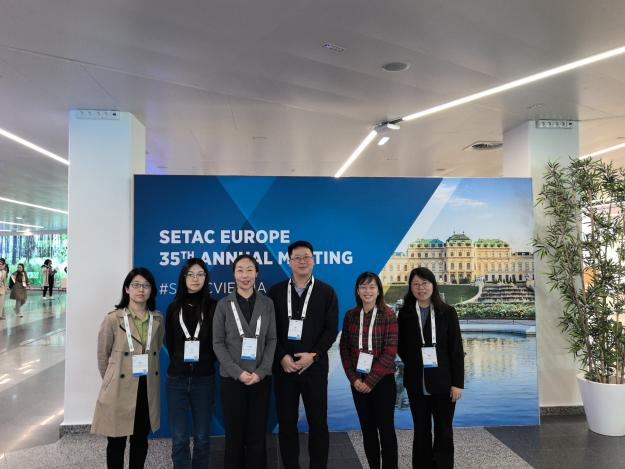
From May 11 to 15, 2025, the 35th Annual Meeting of the Society of Environmental Toxicology and Chemistry Europe (SETAC Europe) was successfully held in Vienna, Austria. With the theme “Innovation for Tomorrow: Progress in Safe and Sustainable Concepts”, the conference attracted over 2,700 participants from 38 countries. A six-member delegation from the Nanjing Institute of Environmental Sciences (NIES), led by Research Fellow Bu Yuanqing, was invited to attend the meeting.

Photo of NIES delegates at the venue
The conference featured seven themed sub-forums, 450 oral presentations, and 1,860 poster sessions, covering hot topics such as environmental toxicology, ecological risk assessment, green chemistry, and the application of artificial intelligence in environmental sciences.
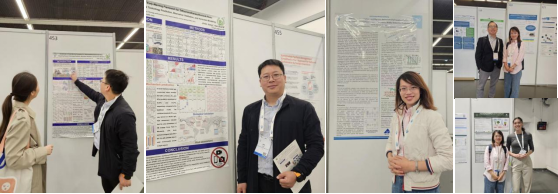
The NIES research team actively participated in various activities to present their research. Dr. Bu Yuanqing, Dr. Jiang Jinlin and Dr. Wei Jing respectively presented their research on "A machine learning-based QSAR model to predict the acute toxicity of commercial pesticides to earthworms", "Constructing an early warning framework for the risks of trifluoromethanesulfonimide (TFMSI)" and "Environmental behavior of rubber antioxidants and their transformation products in abandoned industrial sites" at the conference. They presented China's advancements in research pertaining to the control of new pollutants, ecotoxicology, and environmental risk assessment, which garnered significant interest from the attendees.

Onsite academic exchange
During the meeting, the editorial office of Eco-Environment & Health (EEH) engaged in extensive exchanges with international experts and journal editors. Discussions were held with editorial board members on special issue planning and international conference cooperation. Insights were also shared with SETAC journal editors regarding manuscript review processes and optimization of academic publishing. Invitations to contribute were extended to renowned scholars to jointly advance the application of machine learning in environmental toxicology research.
SETAC was established in 1979 as an international non-profit professional organization. It dedicated to advance the research, analysis, and resolution of global environmental challenges, alongside the management and strategic planning of natural resources. SETAC holds a prominent position among the most influential societies within the domain of international environmental toxicology and chemistry.